
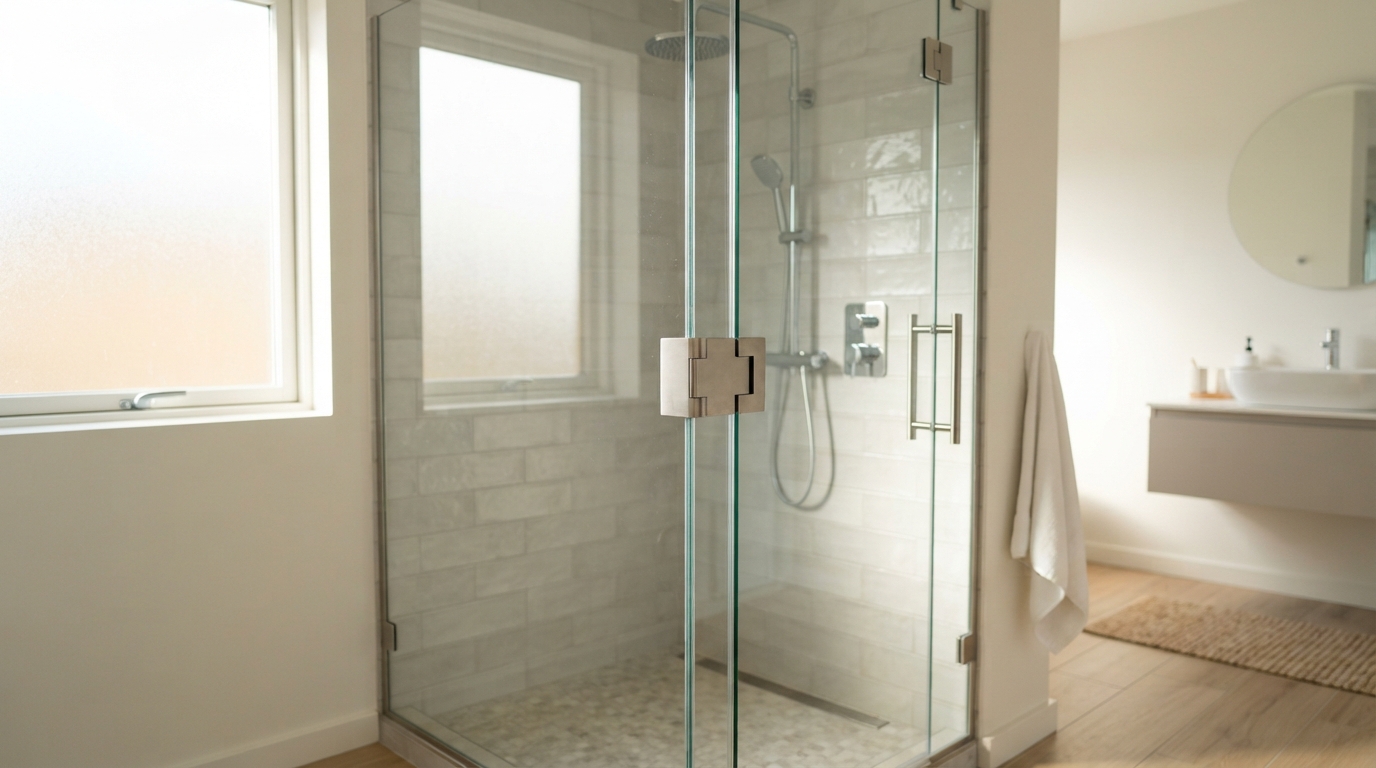
Recap:
• Frameless doors use thicker tempered glass and minimal hardware, while framed doors rely on a metal frame and thinner glass for support.
• Framed units generally cost less upfront but require more cleaning around tracks and channels; frameless designs cost more but clean faster.
• Measurements, glass tint, handle type, and hardware finish all factor into a custom shower door order in Carol Stream, IL.
Choosing between frameless and framed glass shower enclosures comes down to budget, bathroom layout, and how much upkeep a household wants to take on. Both styles use tempered safety glass, but the way that glass is supported changes its look, price, and maintenance needs. At Hanover Glass & Mirror Company, a family-owned business serving the Chicago land area, we help homeowners weigh these tradeoffs every day. Whether you’re drawn to a sleek frameless design, a semi-frameless option, or a classic framed door, our team can guide you toward the enclosure that fits your space, your style, and your budget.
Custom Glass Shower Doors are typically ordered after a bathroom is measured for width, height, and any irregularities like bowed walls or angled ceilings. A measured fit improves water control and lets a homeowner select glass tint, handle style, and hardware finish before the door is cut and installed.
Framed vs. Frameless: What Actually Changes
The core difference is structural. A framed door uses a metal perimeter that supports thinner glass, while a frameless door relies on thicker glass and minimal hardware to stand on its own.
|
Feature |
Framed Doors |
Frameless Doors |
|
Typical glass thickness |
Thinner, metal-supported |
Thicker tempered glass |
|
Upfront cost |
Lower |
Higher |
|
Water sealing |
Frame aids containment |
Depends on precise seals |
|
Cleaning |
More surfaces to wipe down |
Fewer tracks and channels |
Framed systems tend to cost less because the frame allows for thinner, lighter glass and simpler hardware. Frameless doors shift that cost into thicker glass and sturdier clips or hinges, which is part of why they are often priced higher per installation.
Maintenance Differences Worth Planning For
Water spots, soap residue, and mineral buildup affect both door types, but the amount of surface area that traps grime differs.
• Framed doors have metal tracks and channels that can collect moisture and require more frequent scrubbing.
• Frameless doors have fewer metal components, which generally means less time spent cleaning tracks.
• Hard water areas may still leave mineral deposits on either glass type regardless of frame style.
Because tempered glass is considered a safety glazing material, installation standards matter for both styles. The Insurance Institute for Business & Home Safety notes that properly specified tempered glass is designed to reduce injury risk if broken, which is one reason professional measurement and installation are recommended for shower enclosures rather than off-the-shelf kits.
Custom Measurement and Design Considerations
Ordering a custom shower door is different from buying a standard box-store unit. A custom order accounts for the exact dimensions and irregularities of a specific bathroom.
1. Measuring the shower opening, including any bowed walls, angled surfaces, or sloped ceilings.
2. Selecting glass texture, tint, and privacy level.
3. Choosing handle style and hardware finish, such as stainless steel or matte black.
4. Confirming door configuration, including sliding, swinging, or fixed-panel layouts.
Homeowners in Carol Stream, IL, working on a bathroom remodel often need these adjustments because older housing stock in the area can have walls that are not perfectly plumb, which affects whether a frameless or semi-frameless design will fit without gaps.
Deciding Which Style Fits a Bathroom
Neither framed nor frameless is objectively better across every bathroom. The decision usually comes down to three factors: available budget, how much weekly cleaning a household wants to do, and whether the bathroom’s existing walls are plumb enough for a frameless fit.
• Smaller bathrooms with tighter budgets often do well with a classic framed enclosure.
• Larger or remodeled bathrooms aiming for an open, spa-like look tend to favor frameless or semi-frameless designs.
• Bathrooms with benches, half-walls, or limited entry clearance may need custom measurements regardless of frame style.
Frequently Asked Questions
Is a frameless shower door worth the extra cost? It depends on priorities. Frameless doors generally require less scrubbing of tracks and channels, but framed doors remain a practical lower-cost option for water containment in straightforward bathroom layouts.
Can a custom shower door fit an irregular or older bathroom? Custom measurements can account for bowed walls, angled surfaces, benches, and limited clearance, which is common in older homes throughout Carol Stream, IL, and surrounding suburbs.
Does glass thickness affect safety? Shower doors use tempered safety glass, which is designed to break into small, less sharp pieces if damaged rather than large shards, regardless of whether the door is framed or frameless.
How long does a custom installation take to plan? Timelines vary by bathroom complexity, but the process generally starts with an in-person or on-site measurement before glass tint, hardware, and configuration are finalized.
Bathroom glass needs in Carol Stream, IL, can be reviewed in person for measurement and design options; business details and customer reviews for View Hanover Glass & Mirror on Google Maps are available for anyone comparing local glass providers before scheduling a consultation.